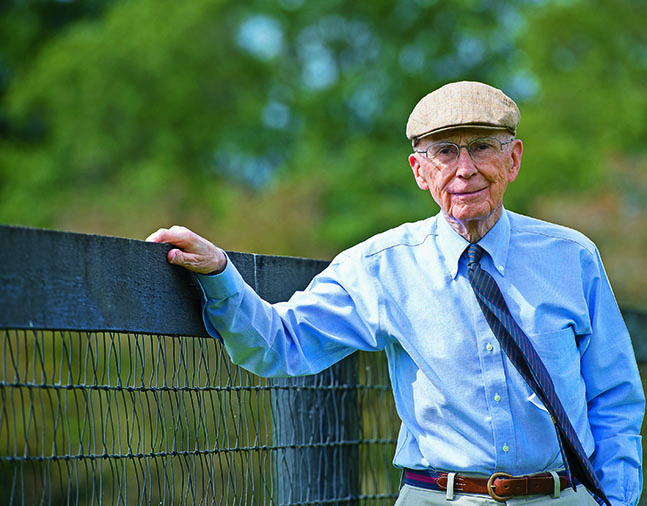
Dr. Robert W. Copelan
Dr. Robert Copelan had been a veterinary school graduate for only a little more than a year when he spearheaded the creation of one of American racing’s most impactful horse care initiatives of the 20th century. In December 1954, Dr. Copelan and two colleagues organized a gathering that established the American Association of Equine Practitioners (AAEP) at the Brown Hotel in Louisville, Kentucky. Dr. Copelan was one of 11 vets in attendance at the foundational meeting. A constitution for the organization was written and adopted at the meeting — and history was made.
2026
Sept. 2, 1926, Cincinnati, Ohio
Biography
Dr. Robert Copelan had been a veterinary school graduate for only a little more than a year when he spearheaded the creation of one of American racing’s most impactful horse care initiatives of the 20th century. In December 1954, Dr. Copelan and two colleagues organized a gathering that established the American Association of Equine Practitioners (AAEP) at the Brown Hotel in Louisville, Kentucky. Dr. Copelan was one of 11 vets in attendance at the foundational meeting. A constitution for the organization was written and adopted at the meeting — and history was made.
The instituting of the AAEP proved to be a landmark event in equine veterinary science. Copelan, a Cincinnati native who graduated from The Ohio State University College of Veterinary Medicine in 1953, recalled the impact of the organization’s founding during a 2018 interview with BloodHorse magazine.
“From that, each year we gained new members,” Dr. Copelan said. “Anybody who wanted to get out scientific information or wanted to discuss various treatments. Now we have 10,000 members in 50 countries. Of all the stuff I’ve been associated with, gosh, that’s a big thing.”
Dr. Copelan’s father was a newspaper editor at the Cincinnati Times Star. After being discharged from the Army in 1945, Dr. Copelan decided to follow in his father’s footsteps and study journalism at Ohio State, but those plans changed quickly.
“So on my first day in the College of Journalism, I arrived early, and right across the avenue was the College of Veterinary Medicine, and out of the window I saw them unloading a racehorse named Talked About, by The Porter, out of Lucille Wright,” Dr. Copelan told BloodHorse. “He was a Calumet castoff. I got up from my chair, went down the stairs, walked across the street, and never went back.
“I watched them block that horse’s leg and fired that horse. He had no reaction to the 1,100-degree heat they were putting into his ankles, and I was mesmerized. I had to know more about how all that worked and how you did it.”
Dr. Copelan found his life’s calling that day. He immediately switched gears and went on to spend the summers of his college years as an exercise rider at Beulah Park and Darby Dan Farm in Ohio. He eventually made his way to Calumet Farm in Lexington, Kentucky, where he broke yearlings and assisted the farm vet, among other duties. One of the horses he worked with at Calumet was Hill Gail, who went on to win the 1952 Kentucky Derby. Dr. Copelan watched from the roof of Churchill Downs as Hill Gail won the Run for the Roses by two lengths before a record crowd of 110,000. Describing the Derby experience, Dr. Copelan said, “ … of all the things that have happened to me in my life, nothing topped that feeling.”
After his graduation from Ohio State, Dr. Copelan worked as a track vet at several racetracks and opened his own practice in Paris, Kentucky. His skills as a surgeon were renowned and he became a go-to practitioner. During his career, Dr. Copelan provided veterinary care for 16 Kentucky Derby winners — including 1973 Triple Crown winner Secretariat — as well as hundreds of additional Derby starters among thousands of horses he treated.
Dr. Copelan became a pioneer in equine joint surgery at his hospital at Sunnyside Farm. He developed and enhanced procedures that “enabled the veterinary profession to address and solve problems which formerly were without solution,” stated a biography about Dr. Copelan from the Thoroughbred Club of America’s 76th Annual Testimonial Dinner in 2007, at which Dr. Copelan was the Honor Guest.
One of Dr. Copelan’s most famous success stories was Hall of Famer Susan’s Girl, who suffered a broken sesamoid in 1974 after two championship seasons. Following surgery performed by Dr. Copelan and more than seven months of rehabilitation, Susan’s Girl made it back to the races late in 1974. She returned to top form the following year, winning the Eclipse Award for Champion Older Mare for a campaign in which she made 17 starts with a record of 7-4-4. Susan’s Girl won five graded stakes after the surgery and became the first filly or mare raced exclusively in the United States to surpass $1 million in career earnings. She was inducted into the Hall of Fame in 1976.
Fred Hooper, who owned Susan’s Girl, later bred the mare to Tri Jet. The result was a bay colt that Hooper named Copelan, who won in succession the Sanford Stakes (G2), Hopeful Stakes (G1), Futurity Stakes (G1), and Champagne Stakes (G1) as a juvenile in 1982.
Along with his work at racetracks and his private practice, Dr. Copelan also notably became a key bloodstock advisor to William T. Young and his Overbrook Farm breeding and racing operation. It was Dr. Copelan’s suggestion that Young hire the up-and-coming D. Wayne Lukas as his trainer. For Overbrook, Lukas saddled numerous graded stakes winners, including Breeders’ Cup Classic (G1) winner Cat Thief, as well as Snow Ridge and Surfside, among others.
“A lot of the decisions at Overbrook were made by committee during a weekly meeting,” Lukas recalled in the 2018 BloodHorse article. “We’d sit there and discuss different horses, breedings, who to sell, who to race, what to run in. Bill had the final vote, but there was a lot of discussion, and Bob Copelan brought stability and sensibility to the whole thing.
“There was a spirited discussion about whether Cat Thief should run in the Breeders’ Cup Classic because he had run poorly in the race before. We went around and around and finally Copelan stood up and made the case in black and white, and when he sat down, the whole table went our way.”
Lukas also praised Dr. Copelan for the work he did on the Overbrook colt Grindstone. Dr. Copelan and Dr. Larry Bramlage together performed arthroscopic surgery on Grindstone’s front knees and ankles in August 1995. On the first Saturday in May the following year, Grindstone became a Kentucky Derby winner.
“Bob Copelan was responsible for Grindstone winning the Kentucky Derby,” Lukas said. “Never would have happened without him. He’s a perfectionist and remarkable in everything he does.”
Claiborne Farm’s Seth Hancock, who was voted into the Hall of Fame as a Pillar of the Turf alongside Dr. Copelan in 2026, added, “Bob Copelan is one of the greatest veterinarians, horsemen, and human beings I’ve ever met. He has touched many generations and levels of the horse from the track to the farm to equine medicine. He is world renowned in his field … a true giant among horsemen.”