Joseph E. Widener
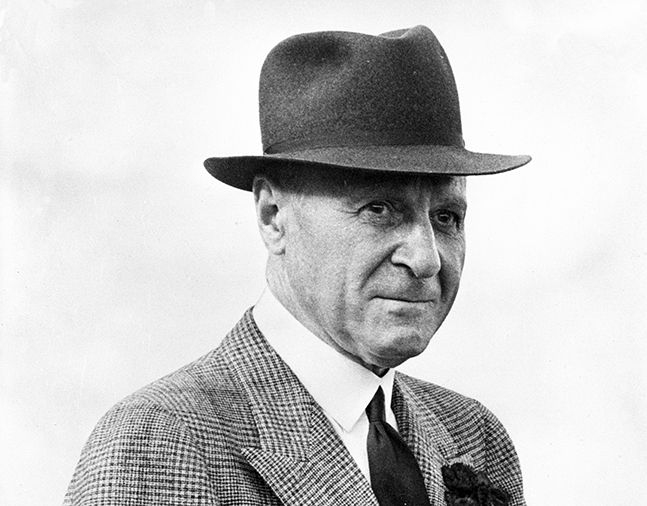
Joseph Early Widener’s greatest passions were fine art and thoroughbred racing. Whether it was cultivating one of the world’s most prestigious art collections or committing to racing as an owner, breeder, and visionary leader, Widener went all in, leaving behind a monumental legacy in both of his beloved pastimes.
2026
Aug. 19, 1871, Philadelphia, Pennsylvania
Oct. 26, 1943, Elkins Park, Pennsylvania
Biography
Joseph Early Widener’s greatest passions were fine art and thoroughbred racing. Whether it was cultivating one of the world’s most prestigious art collections or committing to racing as an owner, breeder, and visionary leader, Widener went all in, leaving behind a monumental legacy in both of his beloved pastimes.
Born in Philadelphia in 1871, Widener was the sole heir of a reported $60 million fortune after his father, Peter A. B. Widener, died in 1915. The elder Widener, who started out as a butcher, began to build his wealth through a chain of meat stores and by signing a contract with the Union Army to provide troops with mutton during the Civil War. His ventures expanded to co-founding the Philadelphia Traction Co., which established electric trolly service in several major cities. Peter A. B. Widener was also heavily invested in the International Mercantile Marine Co. and U.S. Steel and held significant interests in railroads, oil, and natural gas.
The Widener family endured multiple tragedies. Jospeh Widener’s oldest brother, Harry, died in 1871 of typhoid fever at the age of 11. The Wideners were later devastated in 1912 when Peter’s brother, George Dunton Widener, and his son, Harry, died in the sinking of the Titanic. As the lone heir to his father’s fortune after the deaths of his brothers and his mother in 1896, Joseph Widener inherited the Lynnewood Hall family estate near Philadelphia, as well as his father’s renowned art collection.
Educated at the University of Pennsylvania and Harvard, Widener, at the age of 18, dipped his toe in thoroughbred racing with the purchase of two horses, Vendette and Radiant, neither of whom became notable runners. He proceeded to build a stable focused on steeplechasers in the 1890s and early 1900s. Coinciding with his developing equity in the sport, Widener was elected to The Jockey Club in 1909. He later became a steward and vice chair for the organization. When racing briefly shut down in New York in 1911 and 1912, Widener went to France and established a breeding farm there known as Haras du Mesnil. He raced throughout Europe and maintained the farm in France until the outbreak of World War II. Widener’s French racing stable peaked at 75 horses in 1926.
In 1923, Widener and a nephew, George D. Widener, Jr., purchased the famous Elmendorf Farm property near Lexington, Kentucky, and both men established individual breeding operations there. Joseph Widener kept the Elmendorf name — made prominent by James Ben Ali Haggin and Daniel Swigert — while George Widener named his parcel Old Kenney Farm. When August Belmont II died in 1924, Joseph Widener purchased 64 mares, 36 weanlings, and three stallions from the dispersal sale. The highlight of the sale for Widener was his $100,00 acquisition of the stallion Fair Play, who became the leading sire in North America in 1927 for the third time. Fair Play, inducted into the Hall of Fame in 1956, went on to become the top broodmare sire in 1931, 1934, and 1938.
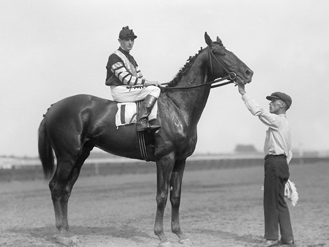
Widener campaigned numerous standouts, including three winners of the Belmont Stakes: Chance Shot (1927), who was sired by Fair Play; Hurryoff (1933), a homebred son of Haste; and Peace Chance (1934), a homebred son of Chance Shot. Widener’s steeplechasers, trained by Hall of Famer J. Howard Lewis, included Hall of Famers Bushranger and Fairmount, as well as standouts Arch Light, Best Play, Duettiste, and Lizard, among 12 total jump champions. Widener won three editions of the prestigious American Grand National with Relluf (1914), Arc Light (1929), and Bushranger (1936). He bred a total of 79 stakes winners, including flat champions Polynesian, who won the 1945 Preakness for Widener’s son, P. A. B. Widener II, and sired Hall of Famer Native Dancer; Stagehand, winner of the both Santa Anita Derby and Santa Anita Handicap in 1938; and Valenciennes, winner of the 1930 Thanksgiving Handicap and 1931 Havre de Grace Cup.
After Belmont’s death, Widener became president of the Westchester Racing Association, which operated Belmont Park. He went on to purchase Hialeah Park in 1929 and set out on a course to make the Miami track a premier destination for winter racing. Widener quickly reimagined Hialeah, hiring architect Lester W. Geisler to design a new grandstand and clubhouse facilities along with landscaped gardens of native flora and fauna and a lake in the infield that Widener stocked with flamingos. With bookmakers ruled off in Florida in 1931, Widner purchased an Australian totalizer and introduced pari-mutuel wagering. The upgrades and enhanced purses enticed the best stables in the East to establish their winter bases at Hialeah. As part of his effort to maintain clean sport, Widener also introduced the first saliva test in America at Hialeah. Under Widener’s leadership, Hialeah became one of the most popular and important racetracks in the world.
Widener also advocated for the pari-mutuel system to be adopted in New York, which became a reality in 1940. Attendance and wagering at both Belmont and Hialeah increased as a result of Widener’s efforts.
Failing health forced Widener to step down from his top roles at Belmont and Hialeah in 1939, but he remained an influential figure in the sport until his death in 1943. Prior to his death, Widener gifted to the National Gallery of Art in Washington, D.C., the greatest private collection in America, which was estimated to have a value of more than $50 million. The 101 paintings included 14 Rembrandts, seven Van Dycks, and a variety of works by Degas, Donatello, El Greco, Monet, Raphael, and Titian, among others.
Following Widener’s death, a fountain was installed at Hialeah in his honor featuring four simple bronze plaques with the words “architecture,” “art,” “humanity,” and “sportsmanship.” Both the art world and thoroughbred racing had lost one of its greatest benefactors. Turf and Sport Digest described Widener as “the most conspicuous figure in the promotion of American racing.”
Achievements
Triple Crown highlights
Won the 1927 Belmont Stakes — Chance Shot
Won the 1933 Belmont Stakes — Hurryoff
Won the 1934 Belmont Stakes — Peace Chance