David A. Whiteley
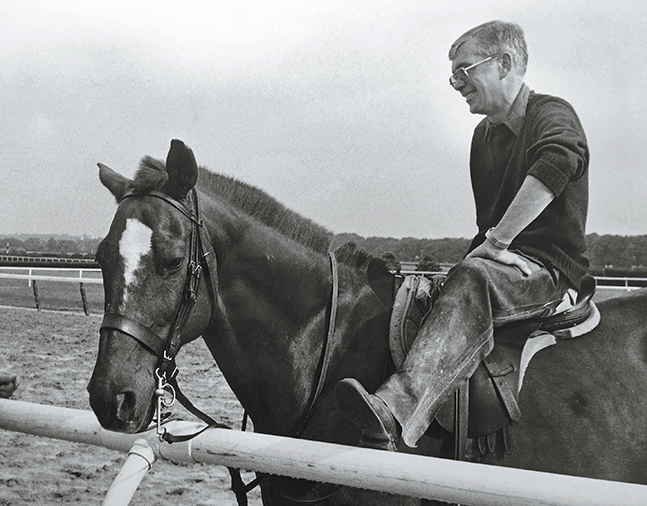
David Whiteley learned how to train racehorses from one of the best to ever master the craft — his father, Hall of Fame trainer Frank Whiteley, Jr. After spending some time as his dad’s assistant, the younger Whiteley went out on his own, applied the lessons he had learned, and established himself as an elite conditioner on his own merits.
2026
Oct. 21, 1944, Easton, Maryland
Aug. 12, 2017, Camden, South Carolina
1970-1995
454
$11,837,823
Racing Record
21.95
Win %
Biography
David Whiteley learned how to train racehorses from one of the best to ever master the craft — his father, Hall of Fame trainer Frank Whiteley, Jr. After spending some time as his dad’s assistant, the younger Whiteley went out on his own, applied the lessons he had learned, and established himself as an elite conditioner on his own merits.
Born on Oct. 21, 1944, in Easton, Md., Whiteley attended the University of Maryland and George Washington University, then apprenticed with his father, before beginning his training career at the age of 25 in 1970. He went on to condition three champions — Revidere, Waya, and Just a Game — and won the 1979 Belmont Stakes (G1) with Coastal, denying Spectacular Bid the Triple Crown. With a relatively small stable, Whiteley won 454 races between 1970 and 1995, making trips to the winner’s circle an impressive 22 percent of the time. Whiteley played the game at the top level, as 62 of his wins were in blacktype races, including 45 graded stakes. He had career purse earnings of $11,837,823.
Whiteley’s first significant horse was Revidere, the Eclipse Award winner for Champion 3-Year-Old Filly in 1976. A chestnut daughter of Reviewer out of the Princequillo mare Quillesian, Revidere was bred by Claiborne Farm and owned by William Haggin Perry. Unraced as a juvenile Revidere posted a record of 8-1-1 from 10 starts with earnings of $324,519 as a 3-year-old. She began her career under Whiteley’s training with seven consecutive victories.
After breaking her maiden at Aqueduct and following with two allowance victories, Revidere had an accomplished summer of ’76 with graded stakes wins in the Cotillion (G3), Coaching Club American Oaks (G1), Monmouth Oaks (G1), and Gazelle Handicap (G2), before suffering her first career loss when second to multiple graded stakes winner Proud Delta in the Beldame (G1). Revidere then won the inaugural Ruffian Stakes (G1) in October and closed out her championship season by finishing third against males in the Jockey Club Gold Cup (G1). Her victory in the Ruffian was a memorable moment for Whiteley, whose father trained the race’s namesake. Revidere delivered an epic performance in the contest, defeating the Argentine-bred Bastonera II by 14 lengths.
Whiteley took over the training of the French-bred standout Waya for owners Peter M. Brant and George Strawbridge, Jr., in 1979. As a 5-year-old that year, Waya was voted the Eclipse Award for Champion Older Mare. Her victories included the Santa Ana Handicap and Santa Barabra Handicap (G1) at Santa Anita Park, the Top Flight Handicap (G1) at Aqueduct Racetrack, and the Saratoga Springs Cup and Beldame (G1) at Belmont Park. Waya carried top weight of 131 pounds in the Santa Barbara (conceding 14 pounds to the runner-up) and 128 pounds in the Top Flight (conceding eight pounds to the runner-up). She was inducted into the Hall of Fame in 2019.
Whiteley enjoyed his best year as a trainer in 1979. He won 34 races from 91 starts (37 percent), including 13 graded stakes, and had career-best earnings of $1,695,515. Along with Waya, Whitely won graded races that year with Clef d’Argent, Coastal, French Colonial, Instrument Landing, and Tiller.
Coastal, a chestnut son of Majestic Prince out of the Buckpasser mare Alluvial, had the same Claiborne Farm/William Haggin Perry breeder/owner combination as Revidere. After a pair of allowance wins in June 1979 at Aqueduct, Whiteley entered the colt in the Grade 3 Peter Pan Stakes at Belmont, which he won by 13 lengths in stakes-record time of 1:47 flat for 1⅛ miles. The Peter Pan win prompted Whiteley and Perry to consider entering Coastal in the Belmont against Spectacular Bid, who had won the first two legs of the Triple Crown and was riding a 12-race win streak.
“Running him against Spectacular Bid may be kind of foolish,” Perry said three days before the Belmont. Whiteley was also non-committal, adding, “The numbers don’t come up well. (Coastal is) an unseasoned horse, and we’d probably be pipe-dreaming it. … We’re getting our suit pressed, but we don’t know if we’re going to wear it. It’s always nice to be ready, but we’d be asking a lot of him to try to beat Spectacular Bid. Mr. Perry is a very prudent man, with a lot of common sense. He’s been a successful owner for a long time, and he hasn’t done it by doing rash things.”
Coastal, however, forced the issue for his connections the week of the Belmont with a bullet six-furlong work in 1:12 flat “on a sloppy, tiring track,” according to the New York Times. Whiteley and Perry became convinced they had a puncher’s chance. Perry decided to take a shot and put up the $20,000 supplemental fee to enter Coastal in the race to take on the mighty Spectacular Bid. The gamble paid off, as Coastal shocked the crowd of 59,073, defeating Golden Act by 3¼ lengths. Spectacular Bid, favored at 3 to 10, finished a tiring third, a neck behind Golden Act.
“My horse was shortening stride at the end, but the others were not catching him,” said Whiteley, who was only 34 years old at the time. “To win it that way makes it even more exciting, and nobody deserves it more than Mr. Perry.”
Coastal won two more races that summer — the Dwyer (G2) and Monmouth Invitational Handicap (G1) — to extend his win streak to six, before placing in Marlboro Cup (G1), Woodward (G1), and Jockey Club Gold Cup (G1) to end his season with a record of 6-1-2 from nine starts with earnings of $468,280.
Anoth standout from the Whiteley barn took center stage in 1980, when Just a Game was voted the Eclipse Award for Champion Turf Female thanks to a seven-race win streak that included the Suwanee River Handicap, Orchid Handicap (G3), New York Handicap (G3), Matchmaker (G2), Diana Handicap (G2), and Flower Bowl Handicap (G2). Whiteley trained the Irish-bred daughter of Tarboosh for Brant.
Whiteley continued to have success into the 1980s with horses such as Highland Blade, French Colonial, Blush, Anti Lib, and Regal Flier, among others. Highland Blade won Grade 1s on both dirt and turf and earned just shy of $1 million. He defeated Hall of Famer Slew o’ Gold, Kentucky Derby (G1) winner Gato Del Sol, and Preakness (G1) winner Deputed Testamony in the 1983 Marlboro Cup (G1) at Belmont. Highland Blade also just missed giving Whiteley a second Belmont Stakes victory when he was beaten a neck in the 1981 edition by Summing.
Regal Flier became Whiteley’s 21st and final graded stakes winner when he scored in the 1987 Appleton Handicap (G3) at Gulfstream Park. Whiteley trained into the 1990s, but his success began to wane, and he retired late in 1995.
Whiteley died at his home in Camden, S.C., on Aug. 12, 2017, at the age of 73.
“He was an excellent horseman who learned from his father, and had tremendous success in New York,” said Hall of Fame trainer John Veitch, who was a close friend. “Many people, such as Shug McGaughey, have gone on to have great success after working for David. He had great owners and had a great career, although it was relatively short.”
Achievements
Triple Crown highlights
Won the 1979 Belmont Stakes — Coastal
Trainer Profile | David A. Whiteley | Equibase is Your Official Source for Thoroughbred Racing Information