Mongo (VA)
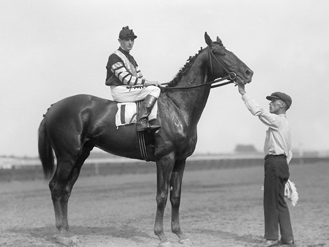
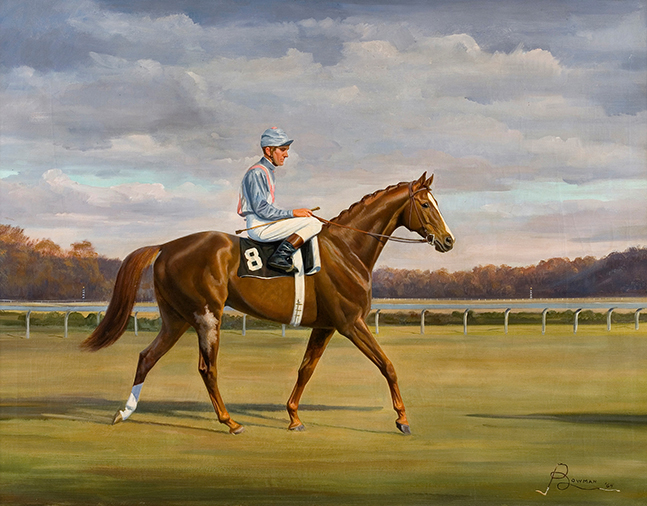
One of the most talented, consistent, and versatile racehorses of his era, Mongo always turned heads. Daily Racing Form’s Charles Hatton said the Virginia-bred chestnut colt “was at once a most attractive individual, perhaps the handsomest in training, and as correctly constructed as the most fastidious could wish.”
2026
1959
Royal Charger
Accra
Annapolis

Marion duPont Scott
Marion duPont Scott
Frank A. Bonsal
1961-1964
$820,766
Racing Record
46
Starts
| 1961 | 8 | 2 | 3 | 1 | $6795 $6,795 |
| 1962 | 11 | 8 | 2 | 0 | $212312 $212,312 |
| 1963 | 14 | 6 | 3 | 3 | $290642 $290,642 |
| 1964 | 13 | 6 | 2 | 0 | $311017 $311,017 |
Biography
One of the most talented, consistent, and versatile racehorses of his era, Mongo always turned heads. Daily Racing Form’s Charles Hatton said the Virginia-bred chestnut colt “was at once a most attractive individual, perhaps the handsomest in training, and as correctly constructed as the most fastidious could wish.”
And he sure could run.
Bred and owned by Marion duPont Scott, Mongo (Royal Charger—Accra, by Annapolis) raced from 1961 through 1964 with a record of 22-10-4 from 46 starts and earnings of $820,766. Trained by Frank Bonsal, Mongo was voted Champion Male Turf Horse in 1963. He won a total of 16 stakes races, including the prestigious Washington, D.C., International and two editions each of the United Nations Handicap, Trenton Handicap, and Diamond State Handicap. Mongo won races at nine different tracks — Aqueduct, Atlantic City, Bowie, Delaware, Garden State, Hialeah, Laurel, Monmouth, and Pimlico — and defeated Hall of Famers Carry Back, Gun Bow, and Kelso twice each.
An impressive pedigree predicted success for Mongo. His sire, Royal Charger, was a prominent stallion and a son of the great Nearco, one of the most prolific racehorses and stallions of the 20th century. Mongo was out of Accra, duPont Scott’s foundation mare. Accra was a daughter of Annapolis, who was sired by Man o’ War. She produced 10 winners from 11 foals, including six stakes winners. Mongo is the second son of Accra to be elected to the Hall of Fame, joining steeplechase legend Neji, a 1966 inductee.
Mongo made his career debut in a five-furlong maiden special weight contest at Pimlico Race Course on May 18, 1961. He was easily the best in a six-horse field, romping by 10 lengths. Mongo’s juvenile campaign, however, didn’t have much more in the way of highlights. Moving to allowance company after his debut victory, Mongo proceeded to lose his next five races before snapping the streak with an allowance score by three-quarters of a length at Laurel Park in October. He concluded his 2-year-old season with a non-descript record of 2-3-1 from eight starts and earnings of $6,795. Better days were ahead.
As a 3-year-old in 1962, Mongo won his first two starts against allowance company at Laurel in April. After finishing second to For the Road in an allowance at Delaware Park in June, Mongo won his next three, including his first turf race, the Ventnor Turf Handicap at Atlantic City, by 10 lengths. With Charlie Burr as his regular rider, Mongo emerged as a force during the second half of his sophomore season, winning the Lexington Handicap at Aqueduct, defeating T.V. Lark in the United Nations Handicap at Atlantic City, besting Carry Back by a nose in the Trenton Handicap at Garden State, and closed his year with a five-length victory in the Pilgrim Handicap in November at Garden State. He had demonstrated his abilities on both dirt and turf and had won from six furlongs to 1¼ miles.
Mongo returned as a 4-year-old in 1963 and proved himself to be one of best horses in the country — and a champion. His victories included the Bowie Handicap, Camden Handicap (at Garden State), Diamond State Handicap (at Delaware Park), Kelly-Olympic Handicap (at Delaware), and a repeat in the United Nations at Atlantic City (defeating Carry Back and Never Bend). He concluded his prolific season with a thrilling half-length win over Horse of the Year Kelso at equal weight in the D.C. International at Laurel in November to secure the title for Champion Male Turf Horse.
The BloodHorse headline after the D.C. International read, “MONGO GRABS GLOBAL GLORY.” Larry Shropshire’s article lauded Mongo’s performance before the crowd of 36,653 as “one of his finest,” and Mongo’s rider, Wayne Chambers, stated simply, “He ran just like Mongo.”
Returning at 5 in 1964, Mongo won the John B. Campbell Handicap at Bowie (defeating Gun Bow), Monmouth Handicap (defeating Kelso and Gun Bow), Widener Handicap at Hialeah, his second Diamond State Handicap, and closed out his career with a second victory and a track record in the Trenton Handicap at Garden State. His time of 2:00 for 1¼ miles in the Trenton bested the previous track mark by a full second. Mongo ranked 11th all time in career earnings when he was retired to stud.
Standing at Blue Ridge Farm near Upperville, Virginia, Mongo had modest success as a stallion, siring 168 winners, including 21 stakes winners, according to Jockey Club records. His notable progeny included Mongongo (winner of multiple stakes races, including the Salvator Mile Handicap), Bushongo (Flamingo Stakes winner), Commadore C. (Long Branch Stakes winner), and Mongo Queen (Sorority Stakes winner).
Mongo died at age 24 on March 21, 1983, at Blue Ridge Farm.
Achievements
Champion Male Turf Horse — 1963
Horse Profile for Mongo | Equibase is Your Official Source for Thoroughbred Racing Information